In my days of being on the cesspit that is Twitter, I would regularly come across people talking about how Dialectical Behaviour Therapy (DBT) was a cruel and unusual punishment for people who had survived absolute horror in their lives. People would talk about the punishing nature of the therapy, the coldness of therapists towards people who needed warmth and validation, and the nastiness of taking away access to telephone coaching for 24 hours after someone had hurt themselves. It was difficult for me to read because, while I had started off with some very negative feelings towards DBT, once I'd trained in it, met some of the DBT evangelists and spoken to people who genuinely believed that DBT had turned their lives around, it was hard to recognise that the manual contained the contempt and harm that I saw people describing. Over time, I was able to recognise some of the practitioners that people were describing, but the manual of DBT and the words and teachings of Marsha Linehan didn't really seem to fit with some of what people were experiencing in services.
My first experience of DBT
My first experience of DBT was working with somebody who found it useful at a time when I knew absolutely nothing about it. This was somebody that many people in the community mental health team had struggled to work with and, as a relatively new member of staff, it was my go now. I went into this with the arrogance of thinking I might be able to be helpful where other people had failed, but also having been primed with the idea that this person was a serial complainer, that nothing was ever going to be good enough, that they were not to be believed or trusted and that, in some ways, working with them could be dangerous to me. Not physically, but the emotional toll of working with them would be something that I would struggle with.
We got off to a good start and they showed me the DBT skills manual and asked me to read it so that we could go through some of it together. Because of the socialisation I'd had around the diagnosis and around them as an individual, I managed to interpret this as some sort of grandiose demand that I had to skill myself up to be worthy of working with them. The more I think about it now, the more I recognise that this was somebody just trying to get help that they knew would be helpful, within a system that was really punishing and rejecting of them. I didn't read the book. I told them I wasn't going to read the book and justified this by saying that I didn't want to teach them things that I had no familiarity or expertise with. I could try to be helpful and I could try to be useful, but I couldn't read something and pretend to be an authority on it when I wasn't. There was some logic to that, but I think I really, really let them down from the outset. I'd given them the impression that I would do something and then done something very different.
There were often times when they would tell me that I should validate them before offering a different explanation to what they'd said. I found this really difficult. I felt like I was being tricked or played, that the person I was working with knew what I should be doing and was marking me on my performance, rather than us having a genuine interaction where I could offer something useful. In retrospect, I think I was really, really invalidating towards them. Again, partly because I'd been socialised into thinking about interactions with them as being something of a war or a challenge, as opposed to a genuine opportunity to help. Here was somebody telling me quite explicitly how I could be more helpful to them, and I'd managed to interpret that as part of the problem.
Learning to walk towards people
My next experience of DBT was a couple of years later when I was working in a specialist ‘personality disorder’ team. DBT was the predominant treatment model there, whereas my background was as an occupational therapist, I'd been working in therapeutic communities and I'd probably read more than the average person about ‘personality disorder’ and ways of working with people who had been given that diagnosis. One of the things I found really difficult was somebody in the team saying to me that soon I'd do my DBT training and then I'd be able to work with people. I had this really jarring sense that I was essentially useless until I'd done my DBT training, which made me hate DBT before I really knew what it was.
One of my trainers was the phenomenal Christine Dunkley, who is an absolute radiant light in terms of how to work with people who are recurrently suicidal and self-harming. I find it difficult to imagine anyone being in a room with Christine, listening to how she uses DBT theory and how she uses herself in her interactions with people, and coming away with the impression that there is something nefarious or underhand about this treatment.
I came away from my DBT training still a little bit sceptical. There were some weird mindfulness exercises and there were protocols and ways of doing things that felt a bit odd. However, one of the things that stuck with me from the training was the idea that if you learnt the DBT skills, you would feel more confident when talking to somebody who was suicidal. You might not use any of those skills, but you would feel more confident talking to somebody than if you didn't know any of them. The more things you knew, the more confident you would feel, even if you didn't use them.
For me, I think one of the best things about DBT is that it makes people comfortable working in an environment that other people avoid. One of the most important things Linehan did was to develop a therapy that actively encouraged practitioners to walk towards people who were suicidal rather than walk away from them. Even if DBT did absolutely nothing for the people receiving it (and I do think it does something for the people receiving it), it helps practitioners feel confident, competent and useful in a way that holds them in the work. If you look at a lot of the therapies that have been developed for people who are recurrently suicidal and self-harming, the support offered to the staff is often comparable to the support offered to the people accessing the service. I genuinely wonder how much of the evidence base for these therapies is attributable to people being supported to do the work, as opposed to being isolated practitioners feeling that they carry all the risk and all the burden by themselves.
A licence to be horrible to people
I can absolutely understand how, if you pick out selected bits of the DBT manual, it can become a licence to be horrible to people. If you miss four consecutive sessions, you're out of DBT. If you've hurt yourself, there is a rule about not being able to access telephone coaching for the next 24 hours. We want to use contingencies to influence behaviour, and this can be interpreted as meaning we should be colder towards people who are doing things that take them away from their agreed goals and warmer towards people who are doing things that take them towards them. I can see how people can leap on those aspects of the therapy as a way of justifying being horrible to people. I can also see how, irrespective of the rationale behind some of these practices, people might experience them as deeply punishing.
However, I think you can probably do something similar with every model of therapy that's out there. If you really, really want to be horrible to people, you can be, and your colleagues and the system around you will often defend you, largely because the discrimination towards people who have been told they have a personality disorder is hardwired into so many of the systems and organisations that we work in. It's relatively easy to aggressively do the minimum for somebody whilst knowing that what you're doing is injurious and unhelpful to them. It's probably even easier to do that when you can convince yourself and the people around you that what you're doing is therapeutic.
One of the things I used to struggle with in DBT was the weekly consultation group. In the consultation group, in theory, the staff apply DBT to each other. I remember that when I was late for a consult group, part of the process was that people would think with me about why I was late. What was it that meant I hadn't been walking through the door at a time when I knew I had an appointment? At what point could I have done something different? How was I going to make it up to the people that I'd inconvenienced by not turning up on time? I found this excruciating. I hated it. I really, really hated it. This was also what we were putting the people accessing the service through. I think it's interesting that, at the time, there was a bit of me that thought this wasn't for me. I had perfectly good reasons for not being there on time. This was an intervention for the people who were mad or ill, and it felt like something of a travesty that it was being done to me. I wonder how often the people we worked with felt exactly the same way.
Later, when I was working in a different team, I would hear practitioners using language such as 'sabotage' or describing people as 'manipulative'. One of the things that you should do in a DBT consultation group, when people are using terms that are a bit pejorative or aren't particularly behavioural, is ask if we can reframe that in a more validating way or describe what somebody is actually doing. I remember some of my colleagues being deeply, deeply uncomfortable when the light was shone on them and they were encouraged to think about why they understood people in the way that they did. There's a bit of me that wonders whether some of those practitioners are the ones who are a little more concrete in how they use the manual with the people accessing the service. If you have a conviction that the people you work with are manipulative, you are going to use the manual as a way of interacting with manipulative people, despite what the person who wrote the manual had to say about manipulation.
What Linehan taught us about manipulation
Linehan's writing about manipulation is some of the most useful stuff I've ever come across in this field. I've written a whole other blog about this, but the gist of it is that if you're being manipulated, if somebody is artfully and skilfully bending you to their will, you probably don't notice. What we often see in this client group is people communicating in ways that are so ineffective that everybody around them is absolutely convinced they're being manipulated and they're furious about it. People are interacting in ways that are damaging their relationships, potentially not getting them what they want, or only getting them what they want at the cost of the relationships around them. Generally, if you take the time to look at people's histories, you can find an abundance of explanation as to why somebody might have learnt to communicate in that way.
I love what Linehan wrote about manipulation because it encourages us to think about people who are struggling to get their needs met, rather than people who are skilfully and maliciously exploiting those around them. These are two very different understandings of the same behaviour and are likely to elicit two very different responses from the people providing care. It was interesting to see how uncomfortable practitioners could become when they were encouraged to adopt the understanding of people that was advocated by the creator of the therapy they were delivering.
The woman behind the therapy
One of the things I think we should celebrate about DBT is that it is a therapy with more lived experience at its heart than probably any other therapy that I'm aware of. It is a programme for people who are suicidal and self-harming, put together by somebody who had been suicidal and had prolifically self-harmed. At a time when we talk a lot about the value of lived experience in the development of services, I think it's worth recognising the extent to which one of the most researched therapies in mental health came out of somebody's own experience of distress and of being on the receiving end of mental health services.
People often describe Marsha Linehan as somebody who lived with borderline personality disorder. If you've read other stuff that I've written, you'll know that I think borderline personality disorder is a nonsense and that we should abolish it as a diagnosis. However, if we are going to use the books that describe mental disorder, we should at least use them properly. One of the things that has always interested me about Linehan's account of her life is the relationship between her admission to a psychiatric hospital and her distress. In accounts of her admission as a teenager, recurrent headaches feature prominently, and it was during her time in hospital that she became someone who was prolifically self-harming and repeatedly trying to end her life. She spent an extraordinary amount of time in seclusion. When I read about her experiences, I can't help but think of some of the people I work with, for whom going into hospital seems to flip a switch and is immediately associated with a massive and sustained increase in risk.
I'm also reminded of the NHS England guidance around autism-informed inpatient care, which highlights how the busy, bright, noisy and unpredictable hospital environment can contribute to dysregulation, overwhelm, meltdown and shutdown, and how services that aren't autism-informed can interpret people's attempts to regulate themselves as challenging behaviour and respond with behavioural approaches. Just for clarity, I'm not saying that Marsha Linehan was autistic. I'm not qualified to diagnose anybody, let alone somebody I've never met. What I am saying is that I'm interested in how readily we attribute the behaviour of somebody in a psychiatric hospital to something disordered within them, rather than thinking about what is happening to them in that environment. I'm less convinced than some people seem to be that Linehan's account of her experiences neatly fits with the diagnostic manuals' description of a pervasive disorder of personality that was non-existent before walking through the door of a hospital.
A big part of me wonders what would have happened if somebody had looked at the teenage Marsha Linehan and said, 'Oh my God, we've put her in hospital and now she's trying to kill herself. Let's get her out of hospital.' We might never have had DBT. We might never have had those years of her being an inpatient, hurting herself and spending vast amounts of time in seclusion. One of the things DBT encourages people to do is to try to find meaning in their suffering, and I hope Linehan took some comfort in being able to do something with the experiences she'd had.
Being real with people
I've interacted with a couple of people who've been very critical of DBT and of Marsha Linehan in particular. I remember being quite interested to talk to somebody who described her as being really cold towards her patients. That might have been the case in some of her interactions, but it genuinely doesn't fit with my experience of reading her work. When I read the DBT manual now, I'm often struck by the warmth and compassion with which she writes about people who are generally excluded and punished within services. Anecdotes are not randomised controlled trials, but somebody I trust told me about meeting Marsha Linehan and how, when she came into the building, one of the first things she did was ask for the Wi-Fi code because she needed to be available in case any of the suicidal people she worked with were trying to get hold of her. The anecdote went on to describe her going to talk to somebody who was suicidal. Again, somebody walking towards a person who was suicidal rather than walking away from them. It doesn't give me the impression of somebody who didn't care about the people she was working with.
One of the other things I really like about DBT is that it encourages practitioners to be real with people. Rather than telling somebody that what they're doing is inappropriate or wrong, we might share some of the natural consequences of what they do. “When you do this, I get frightened, and when I'm frightened, I'm not as motivated to be as helpful to you.” So often I see staff having really strong feelings about the people they work with that they never say out loud; they only act them out instead. When the people accessing services do this, staff criticise them for it, but in some ways it's seen as unprofessional for us to share the reality of the relationship with the person we're working with. In this field, so much of what we've got to offer people is through the relationship. If we deliberately make that something other than a real and genuine one, we can't really complain when things aren't changing because we've deliberately broken one of the most useful tools we've got.
The things we conveniently forget about Marsha Linehan
People quote Marsha Linehan a lot, but there are aspects of what she said that people either can't remember or deliberately won't hold on to. I regularly see people talking about how DBT is not a trauma therapy and how people have to learn to manage in the moment. People seem to forget that a whole stage of Linehan's model is set aside for dealing with the impact of trauma. Whether or not the services providing DBT are actually offering that part of the therapy is another question. I wonder how many people are supported to manage their responses to the horrors they've experienced but never get the opportunity to do anything with the horrors themselves.
People also forget that Marsha Linehan initially set out to design a therapy for people who were suicidal and self-harming. The diagnosis of borderline personality disorder became associated with the therapy as it was developed and researched. When people argue that without a diagnosis of borderline personality disorder people can't access the appropriate treatment, I think it's worth remembering that the treatment we're talking about wasn't originally conceived as a treatment for that particular diagnosis. If you look at the way DBT has subsequently been adapted for use with people with a range of different diagnoses, it's fairly obvious that there is nothing about the therapy that means it can only target people who meet five of the nine criteria in a particular section of the DSM. There was a lot in DBT that I found useful in my own life, just from learning the skills and teaching them to other people.
Perhaps the thing that people most conveniently forget is what Marsha Linehan herself said about the diagnosis of borderline personality disorder. There is footage of Linehan talking about how, if you meet the criteria for borderline personality disorder, “for God's sake, don't tell anybody. People will treat you worse and a lot of people will refuse to treat you at all”. I've also seen her talk about the value of a diagnosis being in its ability to get somebody access to treatment. When people argue that we need to keep telling people that their personality is disordered so they can access DBT, I find it interesting how rarely they acknowledge what the creator of DBT herself highlighted about the harm associated with that diagnosis.
As we increasingly recognise the harm that comes from being told you have a personality disorder, as the Royal College of Psychiatrists has done recently in relation to survivors of abuse, and as we recognise that there is nothing to stop us designing services that people access on the basis of their needs, I wonder whether Marsha Linehan would have got on board with the idea that there is no good reason for telling survivors of abuse that their personality is disordered anymore, if there ever was. What would we lose by continuing to offer people the therapy she developed without exposing them to the discrimination she warned them about?
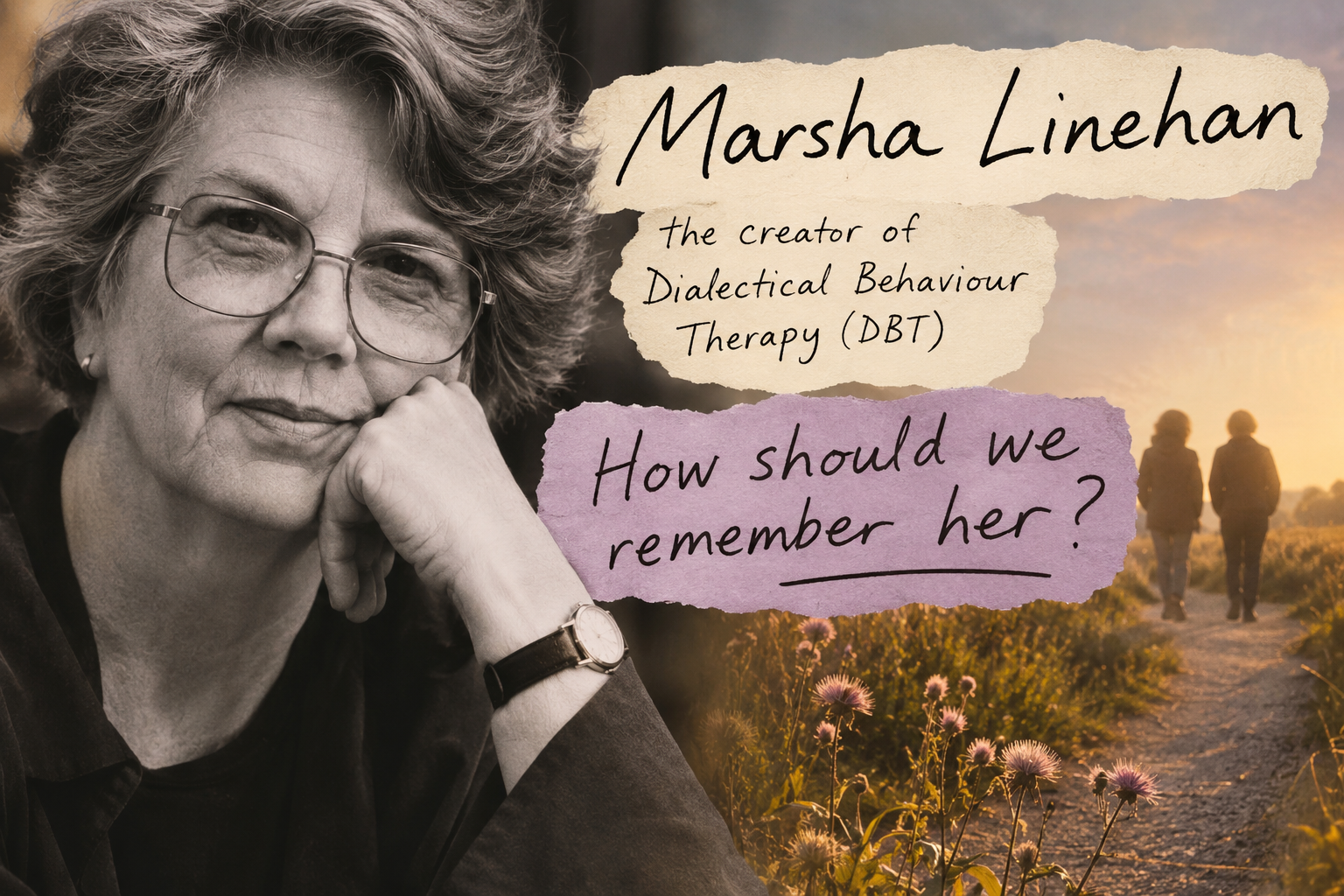
How should we remember her?
When I think about Marsha Linehan and her death, I do think it is a loss to the world. I don't know when the next person who has ‘lived it’ will put together something so influential to help the people who are living it now. I never got to meet her. I know some people who did, who found a massive amount of value in her and her work, and who have gone on to be incredibly helpful to people who have often experienced very little help elsewhere.
I think there's room to celebrate what Linehan did whilst taking very seriously the experiences of people who have been hurt by the therapy she developed. We do those people a disservice if we dismiss their experiences because what happened to them wasn't in the spirit of DBT. Equally, I think we do Linehan a disservice if we remember her primarily through the practices of people who have used her work to justify being cold, punishing and rejecting towards the very people she wanted to help. Perhaps one of the better ways to honour her would be to apply some of the principles of the therapy a little more rigorously to ourselves and to the systems that we work in.
There's plenty to criticise in DBT. There's probably a lot to criticise about Marsha Linehan. But for me personally, she helped make my career survivable. She helped me to validate everything before I suggested a different way of thinking. She taught me to treat people as deserving of compassionate honesty rather than duplicitous cotton wool. Because words matter, she taught me to challenge stigmatising and discriminatory language when it's used to describe people. She taught me that even the most self-damaging actions have value and meaning. She taught me to walk towards people who are suicidal and self-harming, even when services wanted to avoid them. Because of her impact, I haven't walked away since.